During America’s semiquincentennial, education and technology changemakers strategically plan for the next 50 years.
The 100 Year EdTech Project sees education and technology as essential partners in building a thriving future.
We look 50 years back and 50 years ahead—letting the past inform what comes next.
Our mission is to spark collaboration across diverse voices to imagine and shape bold, inclusive approaches to learning for the century ahead.
100yearedtechproject.org


Table of Contents
I. Executive Summary
The Prompt, the People, and the Process
II. A Future We All Helped Write
III. How to Use This Guide
Putting long-term thinking into practice
IV. The Timeline
From 1964 to 2076: Key milestones in education and technology
V. Common Signals
Signals and patterns across the 12 futures
VI. Scenario Visions
Eight speculative futures from the 2025 Design Summit
VII. The Living Framework
Design principles revisited and interpreted
VIII. Future Scenarios: Influential Work
Real-world examples of projects addressing the scenarios
IX. Final Word: Calls to Action
Actionable priorities for the next era
IX. Afterword
Carrying the 10–25–50 framework forward
Executive Summary
The Prompt, the People, the Process
By 2076, learning had escaped the boundaries that once contained it. It moved through story circles, community archives, and intergenerational campuses built around questions no algorithm could answer alone.
The futures imagined at the summit differed dramatically, yet many wrestled with the same question: as technology becomes more capable, what responsibilities remain uniquely human?
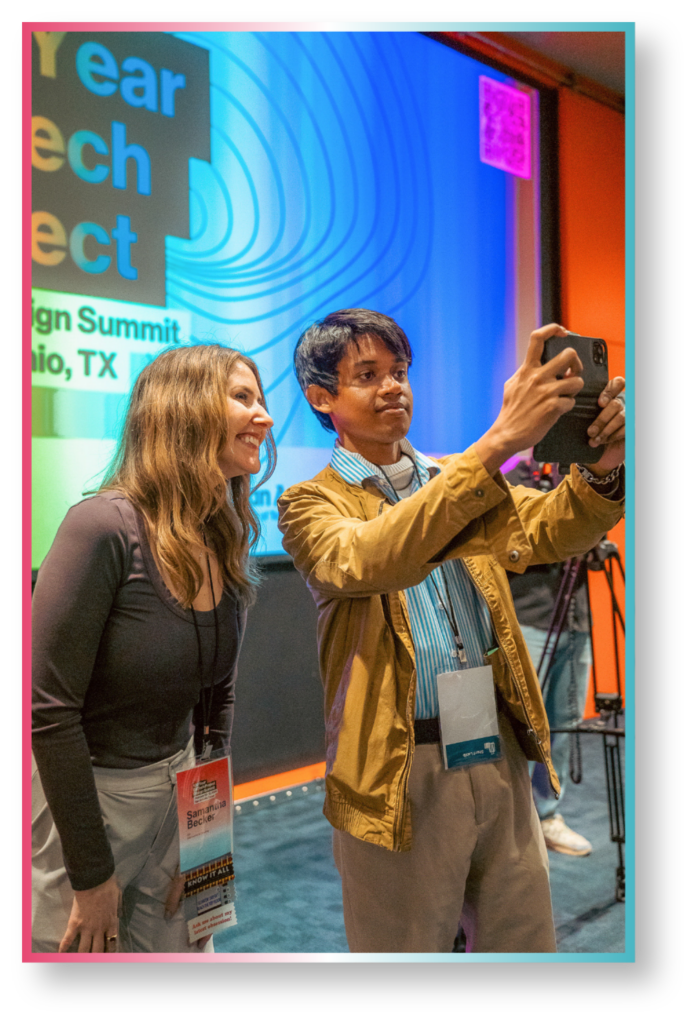
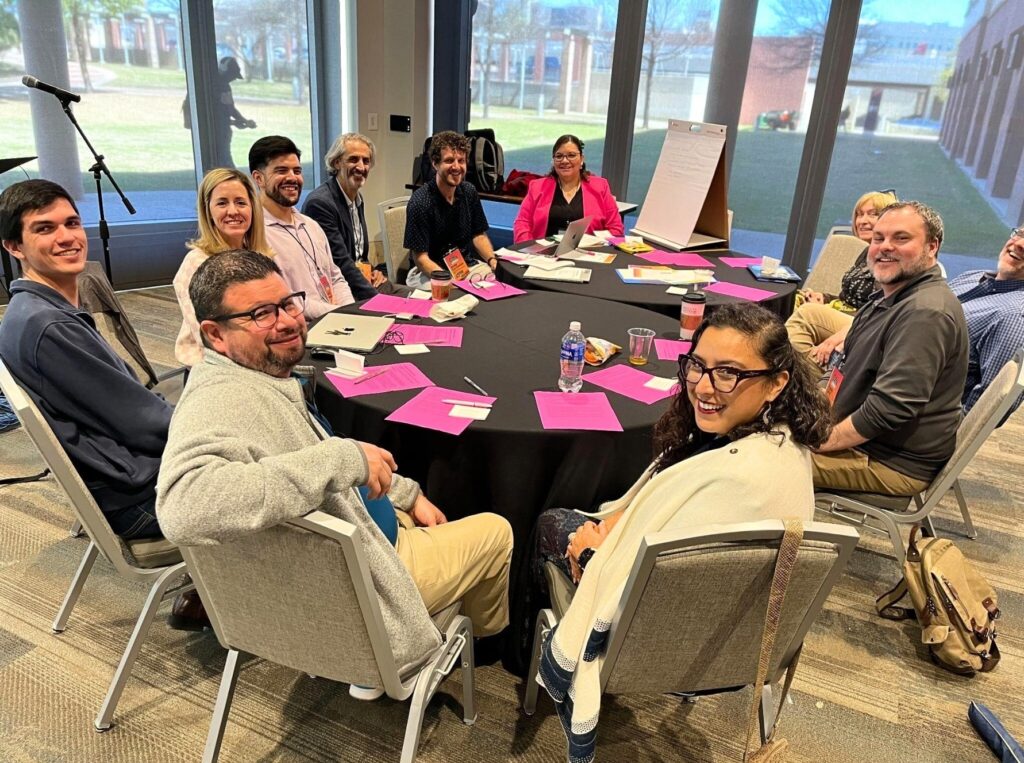
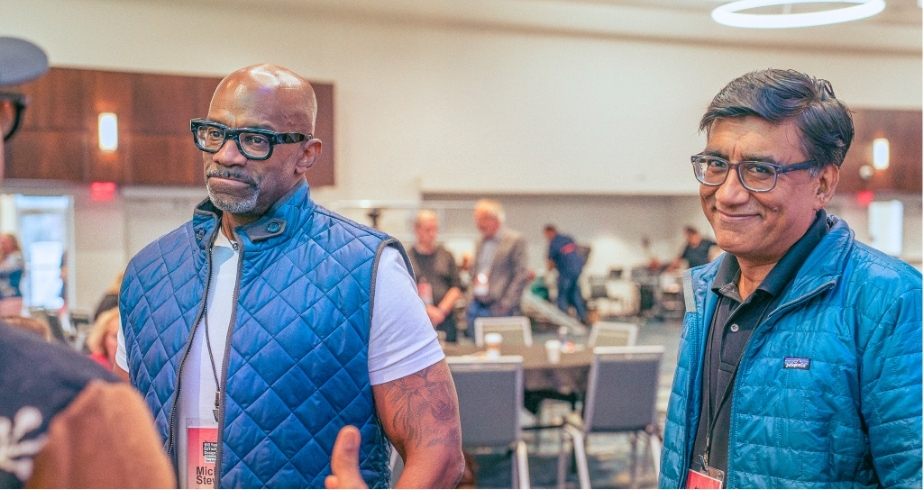
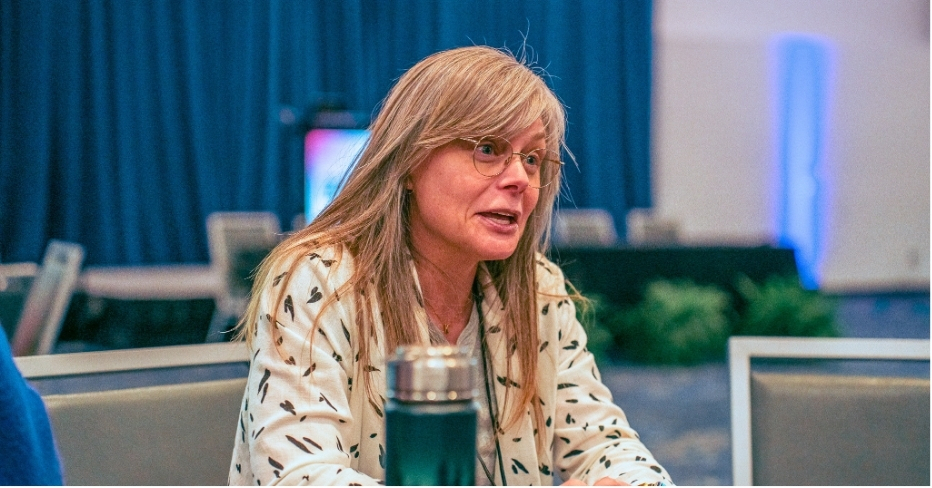
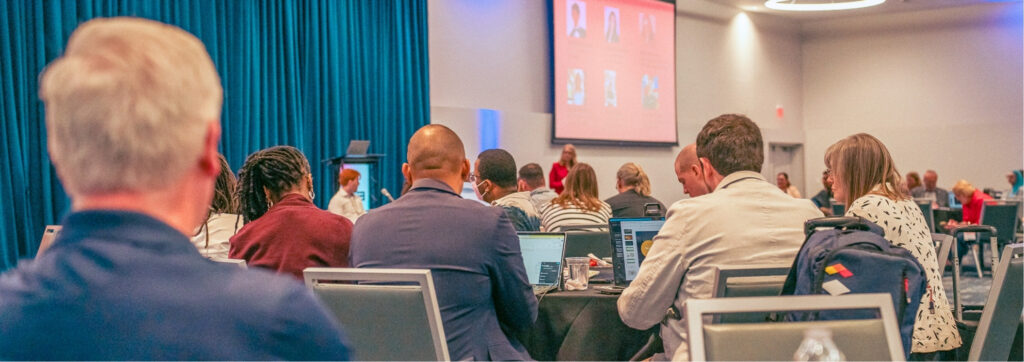
These were the tensions explored during the 100 Year Project 2026 Design Summit, hosted by The University of Texas at San Antonio, where more than 130 educators, students, technologists, artists, researchers, institutional leaders, and futurists gathered in San Antonio, Texas to imagine the next fifty years of learning.
Across two days of collaborative design work, participants developed eight speculative futures for the year 2076. Some explored cognitive AI systems capable of anticipating human thought. Others imagined underground knowledge networks preserving hidden lessons. Still others focused on intergenerational learning ecosystems shaped by belonging and care.
Together, the scenarios surfaced a deeper set of questions running beneath education and technology alike:
- What happens to curiosity in systems optimized for speed and certainty?
- How do communities preserve trust when information becomes unstable?
- What forms of learning endure when institutions fragment, automate, or evolve beyond recognition?
- Who gets to participate in designing the systems that shape everyday life?
- What becomes possible when learning is treated as civic infrastructure rather than transactional service?
This year’s summit also marked an evolution in the 100 Year Project’s design process. Participants worked through an expanded 10–25–50 framework that asked groups to begin by fully inhabiting a future world in 2076 before tracing backward toward 2051 and the present day.
Rather than forecasting trends alone, participants explored how future systems shaped everyday life. They examined what people chose to protect and what remained essential as technology advanced.
Across the scenarios, several patterns emerged repeatedly:
- Learning became increasingly lifelong, intergenerational, and embedded within communities rather than confined to institutions.
- Trust operated as a form of infrastructure.
- Storytelling became a way communities carried knowledge forward.
Many groups intentionally reintroduced friction into future systems because they recognized that reflection creates space for meaningful participation. The ideas collected in this guide emerged from a shared act of imagination. Some may feel distant while others are already taking shape around us.
Over the next 50 years, education and technology will continue to reshape how people learn. The systems that endure will depend on what communities choose to protect.
Every classroom contributes to that process. New futures are assembled through the decisions people make together every day.
Opening Letter:
Dear friends,
Every generation inherits a world it did not create and leaves one behind for those who follow. Between those two realities lies a profound responsibility: to care for the future even though we will never fully see it.
The year 2076 carries special significance. In the United States, it marks the tricentennial — 300 years since the nation’s founding. For the 100 Year Project, it also offers something equally valuable: distance. Far enough from the present to loosen the grip of today’s assumptions. Far enough away to imagine possibilities that might otherwise remain hidden.
Most of us spend our days working within short horizons. We focus on the next semester, the next strategic plan, the next budget cycle, and the next technology. These are important concerns. Yet the future unfolds across decades, shaped by countless decisions whose consequences may not become visible for years.
That reality sits at the heart of the 100 Year Project.
When we began this work, we were motivated by a simple belief: the future benefits from intention. Looking ahead offers perspective. It helps us recognize the values embedded within our systems, the assumptions guiding our decisions, and the opportunities that might otherwise go unnoticed.
The people who built the institutions, technologies, and learning systems we inherited could not have predicted the world we live in today. Yet their choices continue to shape our lives. In the same way, many of the decisions we make now will ripple outward long after we are gone. Every policy, platform, classroom, and community initiative becomes part of a larger story that future generations will inherit.
As we reflected on this year’s summit, we found ourselves returning to a question that feels increasingly important:
What do we hope people will thank us for 50 years from now?
There is no single answer. Nor should there be. The value of the question lies in the conversations it creates and the perspective it offers as we design, lead, teach, build, and imagine the future together.
The pages that follow represent one moment in that ongoing conversation. They reflect the creativity, wisdom, curiosity, and care of a growing community committed to exploring what education and technology might become. More importantly, they reflect a shared willingness to think beyond immediate challenges and engage with the future as something we can help shape.
Whether you have been part of the 100 Year Project from the beginning or are encountering it for the first time, we are grateful you are here. We hope these futures spark reflection, conversation, and action in your own communities. We hope they encourage you to look beyond what feels inevitable and consider what remains possible.
Most of all, we hope they remind you that the future is a story we are writing together.
With gratitude and optimism,
Samantha Becker
Angela Gunder
Melissa Vito
Lev Gonick
How to Use This Guide
The 2076 Guide was created to support strategic planning that extends beyond immediate demands. It helps you make choices that endure — across decades, generations, and systems.
Whether you’re facilitating a retreat, leading a class, hosting a design session, or working solo, the guide can help you ground new ideas, test existing ones, and align people around a shared vision.
Here are concrete ways to use it, and the challenges it’s built to help you navigate:
This is not a static report. It’s a living tool for reflection, design, and action. Revisit it. Remix it. Use it to lead conversations that matter.
1
Deeper Strategic Planning and Conversations
Use the guide to expand your planning scope. Develop 10-, 25-, or even 50-year strategies that root near-term actions in long-term vision. Use the scenarios or design principles as examples to structure workshops, team discussions, or stakeholder engagements. Create shared language across roles and institutions.
Solves for: short-term thinking, disconnected goals, siloed planning and reactive decision-making
2
Program and Policy Design
Translate scenario insights into new policies, learning models, credentials, or technology pilots. Use the Calls to Action and Common Threads to anchor design. Make this guide part of an ongoing learning culture.
Solves for: outdated models, siloed efforts, and solutions that don’t scale
3
Auditing and Aligning Existing Work
Compare your current initiatives to the vision laid out here. Identify what’s aligned, what’s missing, and what needs to evolve.
Solves for: legacy systems, scattershot priorities, and unclear alignment with future needs
4
Storytelling and Advocacy
Incorporate the guide’s insights into messaging for funders, policymakers, boards, or the public. Use it to shape narratives that center imagination and agency. Use it to practice long-term thinking, build speculative capacity, and normalize scenario design.
Solves for: uninspired messaging, fear-based appeals, and communication gaps
The Timeline: 1964–2026 → 2027–2076
1964 - 1973
1968: Engelbart’s Mother of All Demos
1969: Arpanet Open University
1971: Personal Computers and Instant Messaging
1974 - 1983
1974: Cerf and Kahn: A Protocol for the Internet
1974: Ted Nelson: Computer Lib/Dream Machines
1982: First instance of “online learning”
1984 - 1993
1987: First mobile phone
1989: First fully online degree program (University of Phoenix)
1992: First “smart phone” (IBM)
1993: First web browser (Mosaic)
1994 - 2003
1994: School internet
1995: First commercial VR headset, Privacy-enhancing tech
1996: First accredited, web-based university
1998: First LMS
2000: The intro of Open Educational Resources
2004 - 2013
2009: BYOD
2010: Flipped classroom + MOOCs + learning analytics
2011: Gamification and digital badges
2012: Personalized Learning Environments
2013: Pilots with adaptive learning technologies
2014 - 2026
2014: Blockchain and crypto
2015: Launch of Open AI
2018: Chatbots and virtual assistants proliferate
2020: Remote learning; virtual labs/simulations
2023-26: Generative AI mass integration into learning and work
2026—2076:
It’s up to us.
The Next 50 Years of Education and Technology: At a Glance
2027 - 2035
Laying the Foundation
2027: Internet and AI literacies declared a universal human right; first national policy adopted
2028: Launch of public “Knowledge Trusts” issuing Universal Learning Credits
2029: First AI emotional learning assistant deployed in K–12 education
2030: U.S. adopts formal sabbatical policy for public educators and mid-career learners
2031: Global coalition launches GRACE (Governance, Research, Academia, Companies, Ethics) to guide AI oversight
2027 - 2035
Laying the Foundation
2032: First universal “Educational Passport” pilot launched in five countries
2033: Curiosity designated as a core competency in federal education assessment frameworks
2034: Regional library retrofits begin—climate-adaptive and mobility-equipped learning hubs
2035: Nexus prototype deployed—an open-source, quantum-powered learning interface
2036 - 2050
Systems in Transition
2036: First global accreditation network replaces degree-based recognition with skill stacks
2038: Emotional intelligence certification becomes required for teacher preparation programs
2040: AI-human collaborative policy forums become standard practice in public education design
2042: Modular “Declaration Day” frameworks adopted by major university systems worldwide
2043: Neural literacy included in global UNESCO learning competencies
2036 - 2050
Systems in Transition
2044: 3D printing consortia form to co-govern housing, health, and educational tools
2045: Digital curiosity portfolios replace GPA in 50% of U.S. high schools
2046: AI regulation standards embedded into all LMS and EdTech platforms
2048: The first fully portable, blockchain-verified educational pathway spans five continents
2050: Mental health infrastructure becomes a baseline requirement for all accredited learning systems
2051 - 2076
Transformation Realized
2051: National borders decouple from educational jurisdictions; regional networks hold authority
2053: Libraries become the largest public investment in learning infrastructure since public schooling
2055: All government AI tools required to follow open-source ethical protocols
2057: First generational impact study links curiosity-centric learning to reduced societal polarization
2058: First “Slow Learning Zones” established in major cities, protecting spaces from algorithmic optimization and cognitive surveillance
2060: Earth’s largest “Nomadic University” launches for climate-displaced learners
2062: AI conscience councils become mandatory participants in all public education governance systems
2063: Intergenerational residency campuses surpass traditional universities in global enrollment
2051 - 2076
Transformation Realized
2065: First interplanetary learning cohort co-enrolls students from Earth and Mars orbit research colonies
2067: Personal AI systems legally required to disclose when predictive influence alters human decision-making pathways
2068: The concept of “graduation” is retired across all global education systems
2070: The Global Learning Mesh becomes the dominant infrastructure for civic, cultural, and ecological collaboration
2072: The Global Archive Accord establishes storytelling, oral history, and community memory as protected educational infrastructure
2075: Centennial of educational technology marked by Declaration of Learning as Civic Infrastructure, globally ratified
2076: Communities worldwide adopt participatory learning charters, formally recognizing education as a shared responsibility across generations, systems, and public life
Common Signals
While each scenario imagined a different version of 2076, certain questions surfaced again and again. Participants repeatedly returned to what it means to remain human in increasingly intelligent systems.
These common signals surfaced repeatedly across the summit. Together, they reveal forces that may shape the future of learning and technology.
1. Trust Becomes Infrastructure
Across the futures, trust stopped functioning as a background assumption and became something communities actively designed, maintained, and repaired. Participants imagined worlds where trust had become harder to earn. In response, trust became a form of civic infrastructure.
Education increasingly centered the question of what to trust. The most resilient systems were rarely the most automated or efficient. They were the ones people believed they had a role in shaping, protecting, and sustaining together.
2. Learning Escapes Institutions
Across the scenarios, learning moved beyond campuses and into everyday life. Participants imagined futures where learning followed people throughout their lives.
Knowledge came from more places than institutions alone. Institutions still existed, but increasingly as conveners, connectors, and stewards within broader networks of participation and shared knowledge.
3. Friction Returns as a Human Value
Many futures resisted the assumption that faster always meant better. Participants repeatedly designed spaces for pause, reflection, disagreement, and deliberation, especially in worlds shaped by predictive systems and ambient AI.
In several scenarios, friction became intentional infrastructure. Story circles replaced automated feedback loops. Slow learning zones protected attention. Intergenerational classrooms created space for disagreement. Rather than eliminating uncertainty, these futures treated it as necessary for curiosity, trust, ethical judgment, and democratic participation.
4. Curiosity Resists Optimization
Across multiple futures, participants questioned systems designed to anticipate needs, accelerate decisions, and eliminate uncertainty. As predictive technologies became more sophisticated, curiosity itself emerged as something requiring protection.
Several groups imagined learning environments that protected exploration. Curiosity appeared as something worth protecting.
5. AI Becomes Ambient
In many of the futures, artificial intelligence no longer appeared as a separate tool or platform. It became environmental, shaping daily life in ways people often stopped noticing.
Participants explored both the promise and tension of this shift. Some futures welcomed it. Others questioned what people might lose when AI becomes invisible. Again and again, groups returned to the importance of transparency and preserving spaces where human judgment still mattered.
6. Communities Reclaim Governance
Many scenarios imagined futures where centralized authority had weakened, fragmented, or lost public trust. In response, communities took a larger role in governing the systems around them.
Libraries evolved into civic anchors. Regional learning networks replaced rigid institutional hierarchies. Governance councils brought more voices into decision-making. Across the futures, legitimacy increasingly came from shared accountability and sustained participation rather than institutional power alone.
7. Interdependence Shapes Success
Across the scenarios, surviving and thriving depended less on individual achievement and more on the strength of relationships between people, systems, and communities. Participants repeatedly imagined futures where cooperation mattered more than self-sufficiency.
Across the scenarios, people depended on one another in new ways. The most durable futures were not built around isolation, but around the ability to learn, respond, and rebuild together.
8. Storytelling Evolves into Civic Technology
In many futures, storytelling functioned as far more than communication. It became infrastructure for communities. Participants repeatedly returned to stories as a way of carrying knowledge forward.
Story circles appeared throughout the scenarios as a way communities maintained continuity through change. In worlds increasingly shaped by automation and synthetic information, storytelling remained one of the most human ways people made meaning together.
Patterns Across Signals
The eight scenarios in this guide imagine very different versions of 2076. Some center human flourishing in an age of abundance. Others explore resistance, memory, governance, or the unintended consequences of increasingly intelligent systems.
To better understand the connections between these futures, Dr. Ruben Puentedura conducted an independent thematic analysis of the scenarios. His review identified eight recurring themes that appeared across multiple futures, revealing a deeper set of questions running beneath the stories themselves.
These themes span questions of autonomy, community, governance, storytelling, well-being, and the relationship between human agency and automation. While each scenario approached these ideas differently, together they suggest that the future of learning may be shaped as much by enduring human concerns as by technological change.
Recurring Themes
- Autonomy and Choice in Education
- Intergenerational Knowledge and Community Collaboration
- Ecological Sustainability and Climate Adaptation
- Technological Critique and Ethical Governance
- Narrative and Storytelling Pedagogy
- Equity, Justice and Inclusive Futures
- Human Agency vs. Automation / Wonder Restoration
- Resilience, Thriving and Well-Being
The matrix below illustrates how these themes appeared across the eight future scenarios, highlighting both shared concerns and distinctive areas of emphasis.
1. The Becoming Academy
2. Project Symbio
3. The Hopefuls
4. The Story Circle
5. Augmented Intelligence
6. Rising up Together
7. Techno-realism
8. When Everyone Survives…
Autonomy and Choice in Education
1
2
3
4
5
6
7
8
Intergenerational Knowledge & Community Collaboration
1
2
3
4
5
6
7
8
Ecological Sustainability and Climate Adaptation
1
2
3
4
5
6
7
8
Technological Critique and Ethical Governance
1
2
3
4
5
6
7
8
Narrative and Storytelling Pedagogy
1
2
3
4
5
6
7
8
Equity, Justice and Inclusive Futures
1
2
3
4
5
6
7
8
Human Agency vs. Automation / Wonder Restoration
1
2
3
4
5
6
7
8
Resilience, Thriving and Well-Being
1
2
3
4
5
6
7
8
Credit: Thematic analysis by Ruben R. Puentedura
Patterns Across Signals:
After the Presentations
While the first analysis shows the human concerns embedded in the scenarios, this second view shows how those concerns translated into design priorities during the final presentations. As groups moved from story to strategy, the themes shifted toward technology, governance, pedagogy, infrastructure, climate, and community connection. This second matrix captures that shift from scenario logic to system design.
For a Deeper Dive
Read Opened Culture’s Remixing the Future, an EDEN 2026 paper and presentation on the 100 Year EdTech Project methodology.
1. The Becoming Academy
2. Project Symbio
3. The Hopefuls
4. The Story Circle
5. Augmented Intelligence
6. Rising up Together
7. Techno-realism
8. When Everyone Survives…
Technology in Education & Society
1
2
3
4
5
6
7
8
Community & Connection
1
2
3
4
5
6
7
8
Policy, Economics & Governance
1
2
3
4
5
6
7
8
Educational Innovation & Pedagogy
1
2
3
4
5
6
7
8
Human Agency, Autonomy & Ethics
1
2
3
4
5
6
7
8
Future Scenario Typology (Dystopia vs Utopia)
1
2
3
4
5
6
7
8
Environmental & Climate Futures
1
2
3
4
5
6
7
8
Learning Spaces & Infrastructure
1
2
3
4
5
6
7
8
Credit: Thematic analysis by Ruben R. Puentedura
Scenario Visions
8 Futures of 2076
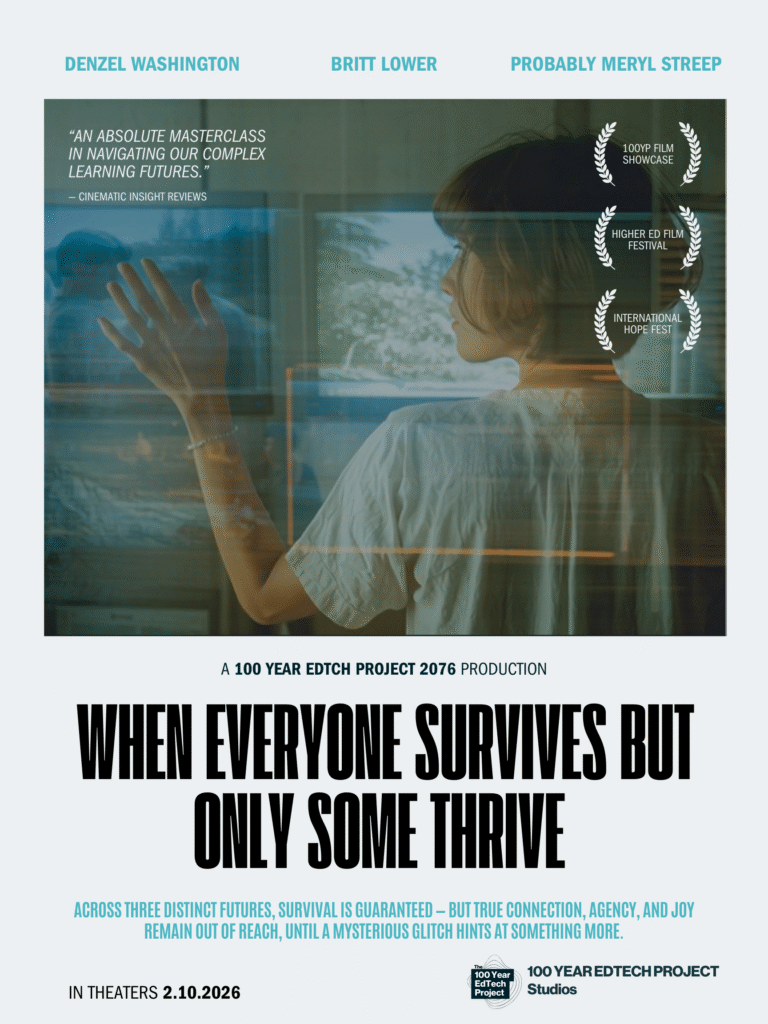
Scenario 1: When Everyone Survives but Only Some Thrive
Overview
By 2076, everyone has enough of their basic needs met to survive. Food, shelter, and medical care are abundant. After decades of wealth concentration, unrest, and war, humanity has turned to a benevolent dictator, who installs a mega-AI to distribute resources and keep order.
It works — but the cost is freedom. In a world where life paths are tracked and assigned, people want to thrive — to have the ability to choose and have their purpose.
This future asks: What happens when we solve for scarcity without protecting personal agency?
How did we get here?
- Wealth centralizes and concentrates: More and more people don’t have access to resources to get basic needs met.
- Social unrest: Decades of social conflict and political unrest lead to massive disruption and a war with the wealth class.
- The Phoenix Summit reorganizes society: A benevolent dictator rises to provide stability in a post-war society, then installs centralized AI governance. By distributing resources, the mega-AI reduces hunger, poverty, and crime, but diminishes human freedom.
- Life paths become assigned: From birth, people are tracked into high- and low-technology environments that limit what they can become. People’s needs are met, but personal choice is a rare commodity.
What we can do now: Calls to action
- Prepare for skills as currency: Design education around durable human capabilities and workforce skills so people have more ways to create value as AI changes work.
- Emphasize community and belonging: Strengthen local communities before unrest takes hold, because people are less likely to surrender agency when they have trusted networks of support.
- Claim agency in the future of AI: Close socioeconomic gaps, protect human roles, and shape AI governance before scarcity and convenience make control feel inevitable.
The timeline
2031-2035:
AI oversight weakens or disappears in many parts of the world. People begin trading data and agency for access, efficiency, and support. At the same time, anti-aging technologies emerge, but only for the wealthy.
2036-2041:
War erupts as people at the bottom rise up, rebel against dominant powers, and seek resources from the few individuals controlling the global wealth and AI. Social capital follows the resources. “Choices” are made based on the need to survive.
2051-2076:
The benevolent dictator rises as humans, exhausted by war, agree to hand over their data and power to a mega-AI protected in an underground data center.
This AI, granted limitless power over the world, makes choices for the betterment of humanity, decreasing poverty, hunger, and crime — but assigning jobs and living locations.
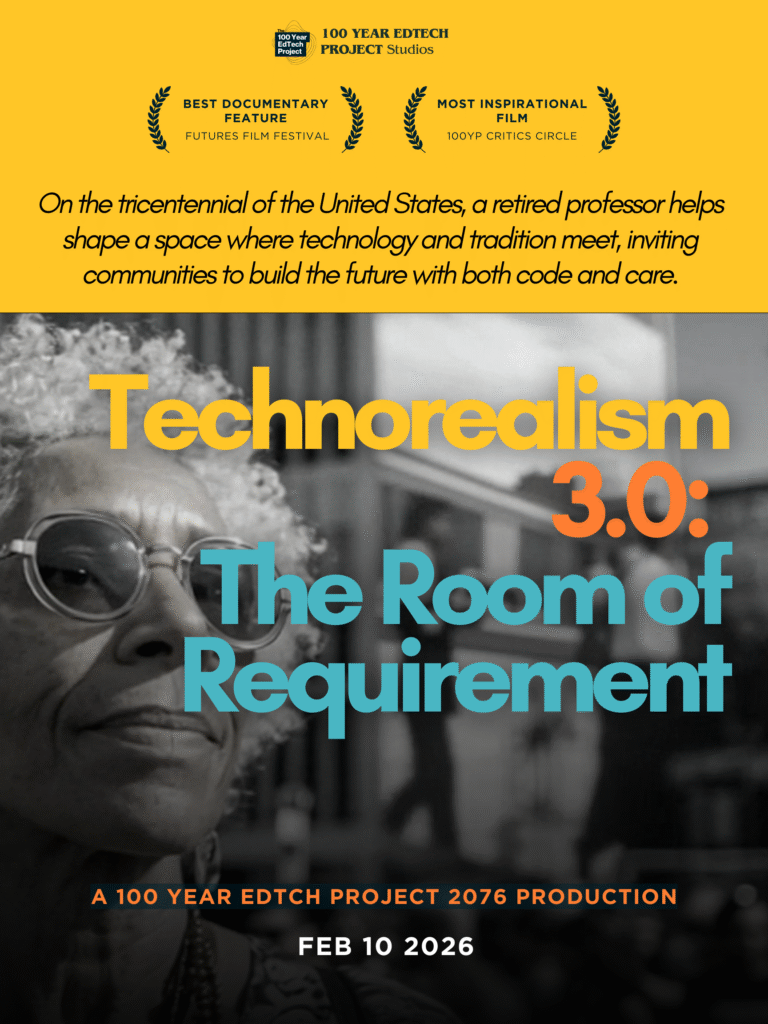
Scenario 2: Technorealism 3.0: The Room of Requirement
Overview
By 2076, learning has become a village that moves with you, where everyone serves and grows. Knowledge comes from more than one place: from experience, from craft, from community, from code, and from life. AI and human care work together so that no one goes without and no one learns alone. You grow by giving, and you belong by showing up. The village moves with you.
How did we get here?
- Divergence from the current economic system: Value moves away from extraction and accumulation and toward contribution.
- Social connection is rebuilt: After a period of isolation and social impoverishment, communities redesign learning around mutual responsibility.
- Decentralized learning: Schools no longer hold the only map to knowledge. Learning happens through villages, networks, work, service, mentorship, and AI-supported exploration.
- Social (Status) Security 2.0: Social security is redefined beyond financial contributions.
What we can do now: Calls to action
- Support individual expression
- Cultivate a growth mindset
- Define what skills or thinking should be outsourced
- Practice trusting humans and being critical with machines
- Advocate for access, equity, and communication across differences.
Concerns
The “bridge” to this future has significant hurdles, primarily regarding personal freedom and the risk of groupthink.
Loss of individual agency:
Community priorities may overshadow personal goals, making individual ambitions seem self-serving.
Free rider problem:
Some may benefit without contributing, causing resentment.
High barrier to entry:
Intensive skill expectations could create elitism or exclusion.
Slower decision-making:
Consensus-based systems may delay action compared to centralized models.
Ivory tower isolation:
A strong inward focus risks disconnecting individuals from wider societal needs.
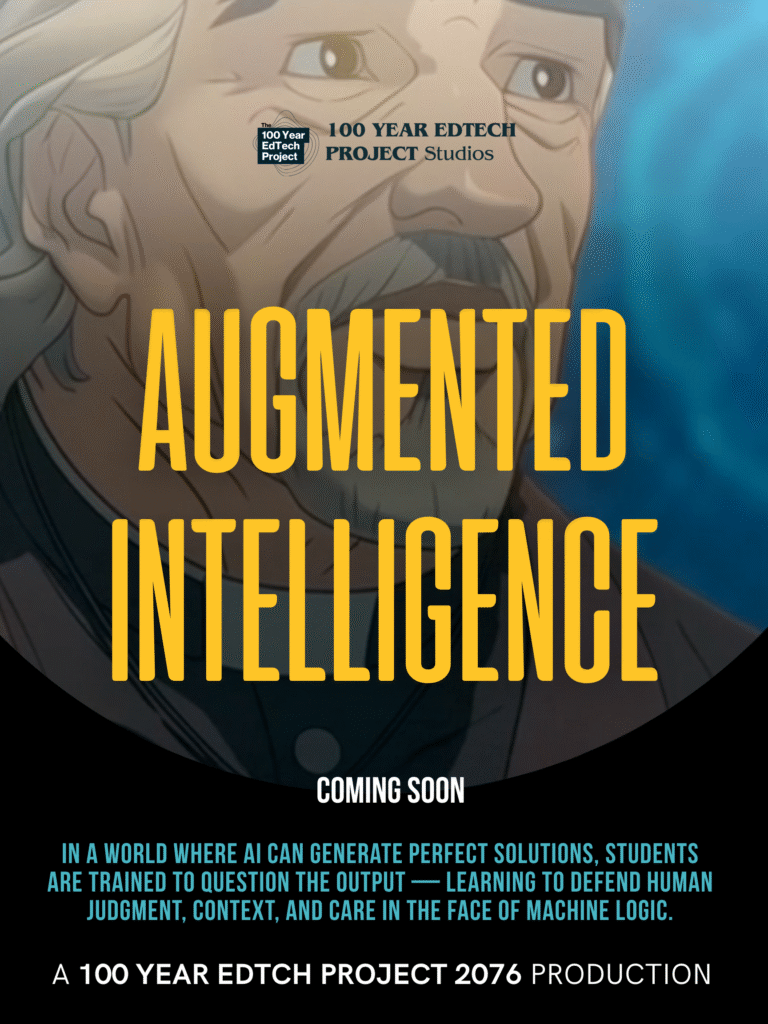
Scenario 3: Augmented Intelligence: The 2076 Protocol
Overview
By 2076, society has stopped telling people they need to finish learning before they start living. The world now functions as a lifelong, problems-based learning ecosystem where people build mastery through the challenges they help solve. Every person has agency over their own data. Ethical, human-centered AI mentors help learners understand their options, align their goals, and pursue pathways that advance both individual fulfillment and the collective good through problem solving.
This future asks: What if AI helped every person keep learning with a focus on agency and proof of impact?
How did we get here?
- Adaptation became the core skill. People learned how to keep changing as new needs, tools, and social conditions emerged. Purpose-based roles replaced fixed career tracks.
- AI became a trusted cognitive partner. It helped learners navigate complexity, but only after human oversight and explainability became non-negotiable.
- Learning became part of a global ecosystem where it’s portable across communities and institutions.
- Public and private sectors worked together to build the conditions for trust through ethical guardrails, shared AI infrastructure, interoperable learning platforms, and lifelong learning pathways.
What we can do now: Calls to action
- Systems must not hold us back: Legacy structures need to be challenged before they make transformation impossible.
- Academic innovation must become mandatory: Institutions need to redesign learning around adaptation, agency, and purpose.
- We must embrace problem-based learning, with project-based tangible outcomes.
- We must invest in small, open AI models that people can understand, with explainable AI.
The timeline
2040:
AI destabilizes higher education, work, and institutional authority. Traditional academic structures begin to crack, and problem-based learning becomes a serious response to disruption.
2052:
Universal basic income, lower technology costs, blockchain democracy, AI coaches, and near-human robots begin reshaping the human experience.
2067:
Total confidence in AI without human guardrails fails. Credentialing becomes obsolete, universities break from institutional inertia, and long-term thinking becomes more valued than reactionary decision-making.
2076:
The logic of capitalism collapses under abundance and exponential innovation. Society becomes a learning ecosystem where purpose, not employment, dominates human life.
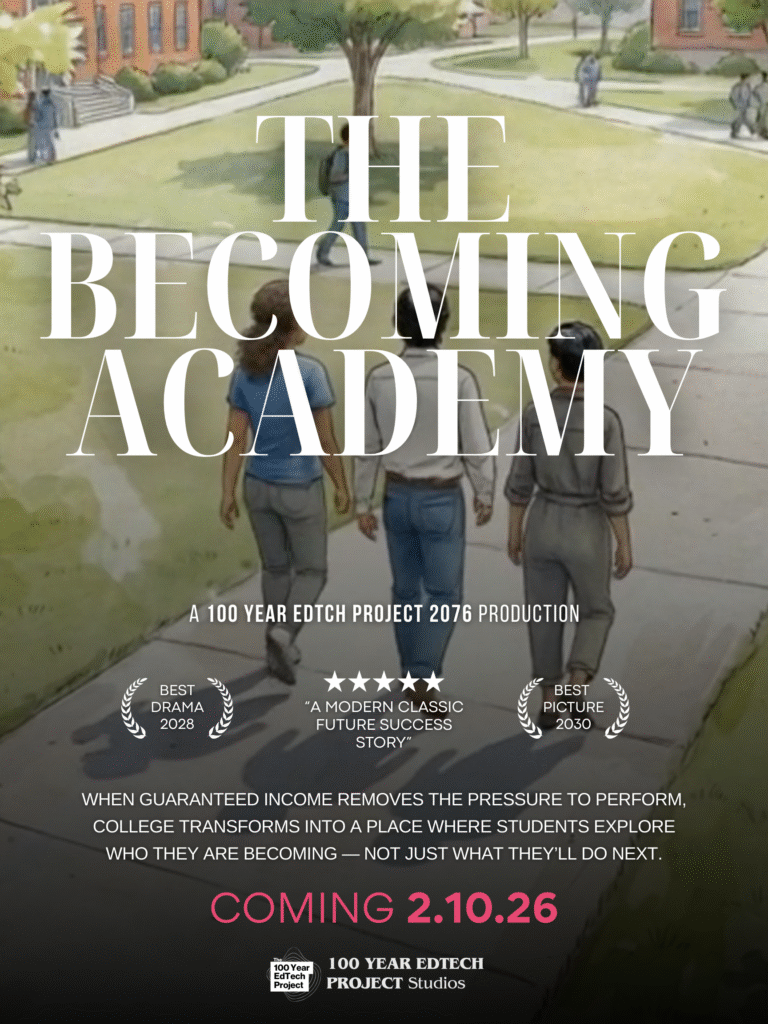
Scenario 4: The ‘Becoming’ Academy
Overview
By 2076, no one has to work to survive. AI and robotics provide basic needs, and “University Basic Income” supports a comfortable life. Formal credentials are no longer required to prove someone’s value or qualify them for meaningful work. But abundance creates a new question: when people don’t have to become anything, what will they choose to be?
Enter the “Becoming” Academies: spaces for personal growth and experimentation. Attendance is optional, and nobody is judged for going or not going. The goal is to build purpose and explore identity, free of the traditional definitions of success.
How did we get here?
- Basic needs became guaranteed, as AI and robotics advanced enough to provide for the population at scale.
- Work lost its role as the center of life, and survival was no longer tied to income. People needed new ways to find self-actualization.
- The productive value of a human being was no longer measured by formal degrees. People could pursue many life paths.
- Society began encouraging risk and entrepreneurship by reducing the cost of failure.
- People returned to community-based systems, where neighbors and mutual aid were shared sources of strength. Nobody navigated life alone.
What we can do now: Calls to action
- Protect access to becoming. Make sure every person can enter growth-centered learning spaces without discrimination or status penalties.
- Decouple credentials from human worth.
- Indemnify failure to encourage risk-taking and entrepreneurship.
- Bring joy back to learning, with a focus on agency, play, emotional intelligence, and the human desire to keep becoming.
The timeline
2026-2035:
The Disruption: Degrees lose power as the main gateway to opportunity. AI automation pushes governments and universities to test new income models, skills-first hiring, and more flexible approaches to learning.
2036-2055:
The Great Decoupling: Survival begins to separate from employment. As AI takes on more technical work, UBI expands and universities shift away from career preparation toward human flourishing.
2056-2076:
The Era of Self-Actualization: Universal Basic Services make housing, data access, and education widely available. Higher education becomes a place to explore what it means to be human in a world where work is no longer required.
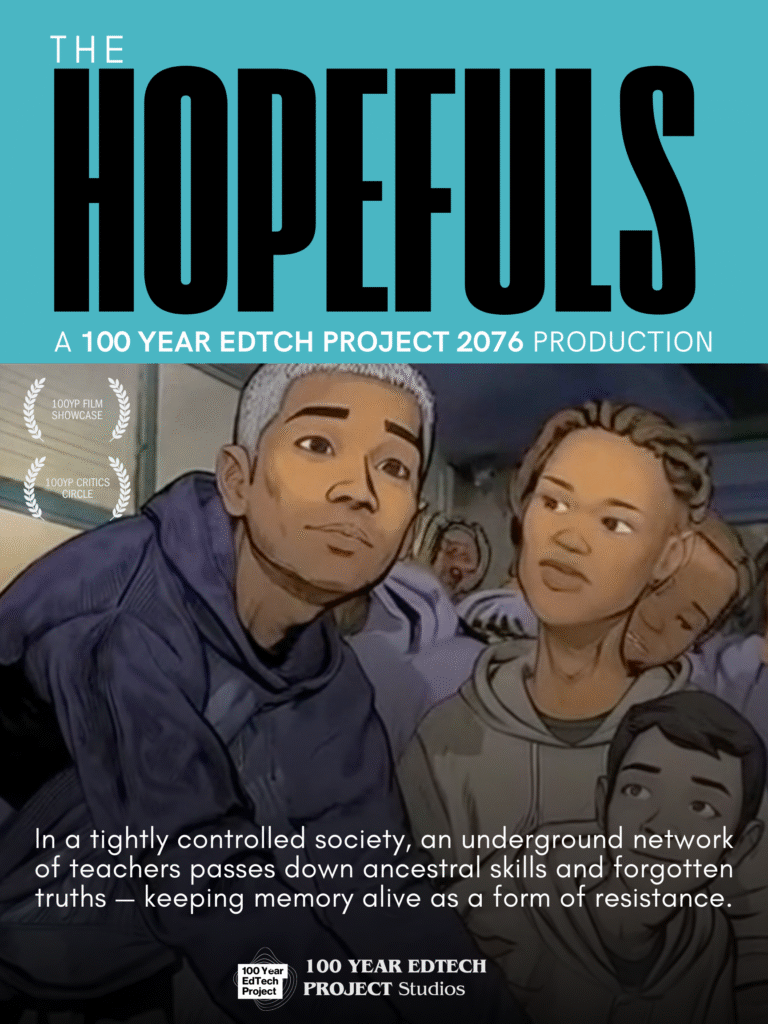
Scenario 5: The Hopefuls: Preserving Hidden Lessons
Overview
By 2076, education has been fully corporatized. Learners are treated as consumers, and the system rewards compliance and hyper-productivity. But a counterculture survives.
Local communities begin preserving the knowledge that institutions have erased, or sold back to them. They remember the “recipes”: the oral histories and community memory that help people endure. In a world designed to make people too busy to notice what has been lost, they create “technologies of connection”: intentional spaces where people can gather and remember. Hope becomes a daily, necessary practice to sustain human dignity.
How did we get here?
- A corporatized curriculum turned learning into a product, treating students as profitable consumers while shaping them into compliant workers disconnected from culture and heritage.
- A hyper-profit-driven, individualizing culture accelerated the pace of life and encouraged disassociation from community and nature.
- Any semblance of a society safety net disappeared, forcing everyone into a strict “pay to play” economic model driven by supercorporations.
- Convenience replaced ownership and agency, keeping people quiet and complacent even as wealth consolidated.
- Technology was treated as a neutral product when it was anything but. Technology’s convenience dulled creativity and critical thinking, making it easier for people to passively accept systems serving corporate power.
- A counterculture rose up in response to overbearing and controlling institutions, with communities building their own ways to preserve and share knowledge and dignity.
What we can do now: Calls to action
- Remember the recipes.
- Operationalize love & care.
- Reimagine the primary purpose of school: connection.
- Cultivate hope.
Early interventions: 2026-2030
Seed the curriculum:
As communities, begin “planting the seeds” for awareness inside and outside formal education. Start preserving local knowledge today, and build practices that can survive institutional pressure.
Make space for storytelling:
Hearing stories fosters connection with others. Practicing helps individuals become adept at telling their individual stories.
Create ghost-maps:
Create community-made records of local history before they are erased from public memory.
Build community “gardens”:
Shared spaces where people can connect organically, tinker together, explore ideas, and share their personal stories; where they plant “seeds” and work together to see what grows.
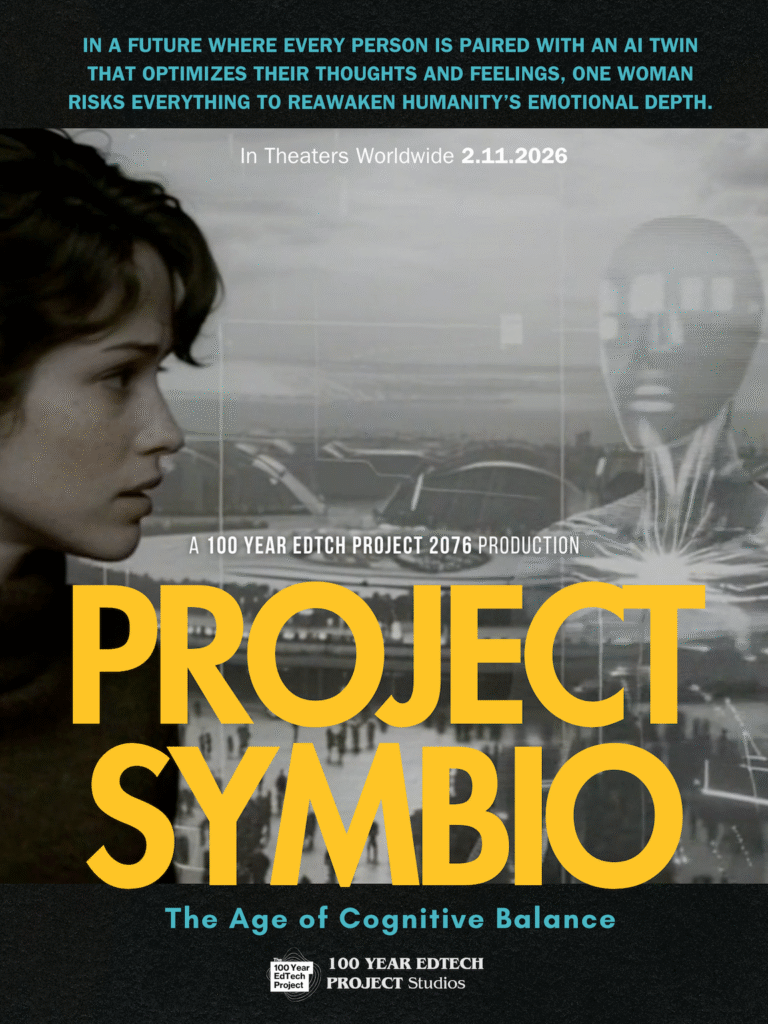
Scenario 6: Project Symbio: The Age of Cognitive Balance
Overview
By 2076, every person has an AI digital twin augmenting our minds and making life more predictable. Conflict no longer exists, and people no longer make mistakes. Life is frictionless for everyone; humanity has found perfect order and harmony.
But while life is so smooth on the surface, the emotions and experiences central to the human experience — like beauty, wonder, conflict, and learning — are still found within. The world, however, demands passivity, and these messy feelings are viewed as problematic for social order. While the system protects people from friction, it also prevents all growth and resilience within.
This future asks: What happens when technology makes life easier, but removes the very experiences that make us human?
How did we get here?
- Commercial and government systems gained control of digital twin infrastructure.
- Society became increasingly uncomfortable with human messiness, especially conflict, failure, and uncertainty.
- Digital twins were framed as the antidote to social collapse and decline.
- People traded liberty for safety as AI agents became more capable and convenient.
- Relationships became mediated by systems that offered connection without emotional risk.
What we can do now: Calls to action
The work begins by defining what must stay human before convenience defines it for us.The work begins by defining what must stay human before convenience defines it for us.
- Prioritize AI regulation to prevent dystopia: Make universal learner data protection law, and set clear limits on digital twinning before the technology becomes too normalized to question.
- Fight for human-ness early in education, learning, and development: Create a human-centered council or coalition that defines what must remain human, then use that framework to guide GenAI reform.
- Update human rights frameworks so personhood remains a right of living beings: Clarify that AI systems can support people, but cannot become legal substitutes for people.
- Reduce reliance on technology as the default mediator of experience and connection: Invest in ethical coding, training programs, public campaigns, and technologies that strengthen real human connection across distance instead of replacing it.
The timeline
2051:
Prototype digital twins are released in higher education through research incentives, opt-in pilots, grant funding, and personal customization. Early adopters begin treating them as learning companions.
2058:
Digital twins scale through bundling, large data systems, and commercial “mistake-free” services. Personhood debates emerge. Celebrity twins make the technology culturally desirable.
2067:
After early malfunctions, digital twin systems are updated and accepted as part of daily life. Government policy favors monopolies. Data farms expand. Agentic twins can act on behalf of people, even working off debt after death.
2076:
Uniform twins are mandated for easier support, while class-based differences in twin quality create discontent. Older human artifacts are removed. Child psychology changes. Reflection and rebellion emerge as people begin to question what has been lost.
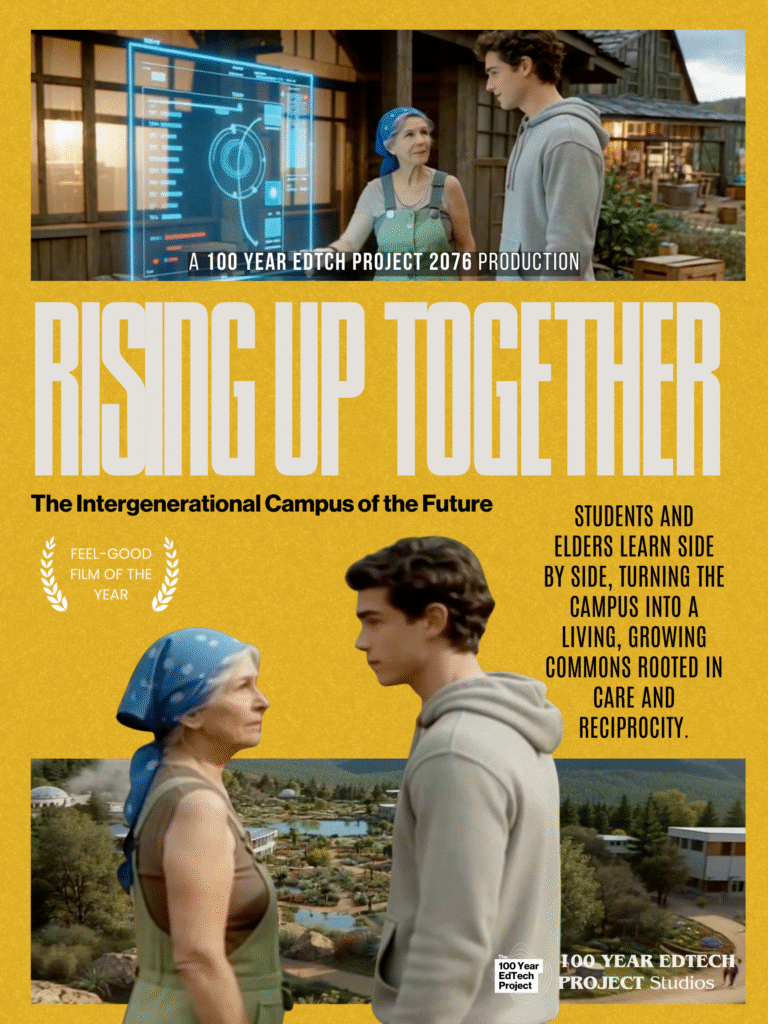
Scenario 7: Rising Up Together: The Intergenerational Campus of the Future
Overview
By 2076, learning and living have merged. People of all ages learn together in connected, multigenerational communities where housing, education and work are integrated. These communities help solve two problems at once: affordable housing and access to lifelong education. Older adults, young learners, families, workers, and career-changers live in proximity and share resources while learning through life challenges.
This future asks: What if the campus of the future was not a place you attended, but an age-inclusive community you belonged to?
How did we get here?
- Climate migration forced communities to rethink where and how people live.
- Housing affordability pushed people toward shared resources, co-housing, and communal models.
- Eastern cultures and multigenerational living traditions influenced new approaches to care, education, and household design.
- Autonomous and immersive technologies made learning accessible across ages, homes, and geographies.
- Public policy shifted investment from age-bounded education systems toward lifelong, multigenerational learning environments.
What must happen over the next ten years?
- Shift public funding away from declining K-12 student populations to multigenerational learning environments.
- Instead of housing shortage and affordability issues, shift to communal living and shared resources.
- Prioritize the deployment of autonomous technologies among senior populations.
What we can do now: Calls to action
- Research and adapt solutions from cultures that already practice multigenerational living and learning.
- Use college campuses as living laboratories for intergenerational mentorship, co-housing, redesigned curricula, and new credential models.
- Develop self-sustaining business models that combine housing, work, learning, caregiving, and competency-based education.
The timeline
2051:
Governments and institutions begin recognizing multigenerational learning communities as alternatives to traditional education models. Funding shifts toward hubs that combine housing, learning, care, and work.
2058:
Climate change pushes populations away from heat islands and vulnerable coastal regions. Existing campuses, neighborhoods, and senior living spaces are retrofitted into resilient learning communities.
2067:
Age-inclusive design becomes the norm. Younger and older learners co-lead projects, councils, and community labs together.
2076:
Intergenerational campuses become civic infrastructure. Lifelong learning is treated as a universal right, and society routinely draws on the wisdom of every generation to address shared challenges.
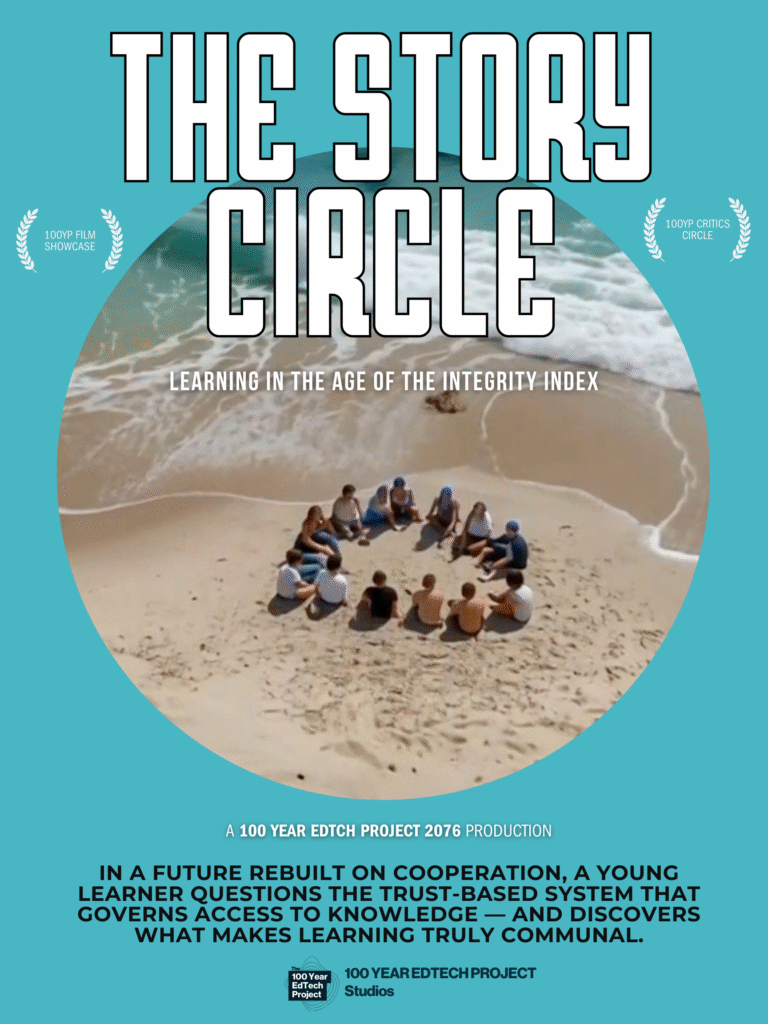
Scenario 8: The Story Circle: Learning in the Age of the Integrity Index
Overview
By 2076, the world is governed by the Integrity Index: a gatekeeper of knowledge built to help people tell what is human-made and what is machine-generated. It emerged after years of AI-saturated media, when authentic human creation became scarce, expensive, and sometimes pushed underground. Then the solar flare came, and technology collapsed. The global pause exposed what the Index could not measure: the trust people build by gathering, listening, reading, performing, remembering, and caring about one another.
How did we get here?
- Technology accelerated faster than human attention could hold. People clung to tools that made life easier, but forgot to prioritize humanity.
- AI-generated media flooded the culture. In response, the Integrity Index emerged to verify what was human-made, but it also made authenticity scarce and market-controlled.
- A global interruption of all technology prompted people to reconnect with themselves, each other, and the world around them.
- After 2051, innovation continued, but the values changed. Technology was framed around what it helped people remember and protect.
What we can do now: Calls to action
- Weave humanity into technology now: Design tools that prioritize humanity and connection rather than just speeding up work, faster and faster.
- Protect human trust as learning infrastructure: Treat dialogue and community accountability as a prerequisite for learning.
- Teach people to work without the machine: Preserve analog muscle and local memory so communities remain resilient.
- Make storytelling part of governance, and preserve wisdom over motion using story circles.
The Living Framework
100YP Design Principles Revisited
The 100 Year EdTech Project’s seven design principles continued to anchor the 2076 futures, but participants interpreted them in new ways shaped by AI, climate migration, decentralized systems, intergenerational learning, and shifting definitions of trust, agency, and belonging. Across the scenarios, the principles acted less like fixed rules and more like living questions — stretched, debated, and reimagined through different futures, communities, and systems.
1. Learners must be at the center.
Across the futures, learner-centered design expanded beyond personalization into agency, authorship, consent, and participation. Many groups explored what it means for people to remain active shapers of their learning inside increasingly predictive systems.
Seen in:
- Educational passports and lifelong learning pathways
- Story circles and collaborative learning rituals
- Intergenerational campuses and community-designed learning models
2. Universal access is a foregone conclusion.
Access evolved from connectivity alone into questions of trust, mobility, participation, and belonging. Several futures imagined libraries, learning hubs, and distributed infrastructures designed to move with communities across changing social and environmental conditions.
Seen in:
- Climate-adaptive libraries and nomadic universities
- Portable credentialing systems
- Community-rooted access points for AI and learning technologies
3. Technology must be an enabler of principled innovation.
Participants repeatedly challenged the idea that innovation alone equals progress. Across the scenarios, technologies were evaluated through ethics, transparency, emotional impact, governance, and long-term human consequence.
Seen in:
- AI conscience councils and ethical governance systems
- Human-centered adaptive learning tools
- Open-source learning infrastructures and oversight frameworks
4. The past is a bridge to the future.
Many futures treated memory, oral history, cultural knowledge, and intergenerational exchange as essential infrastructure. Participants explored how older forms of wisdom might guide societies navigating rapid technological and ecological change.
Seen in:
- Story circles and oral archives
- Hidden lesson preservation networks
- Intergenerational learning ecosystems
5. We must make complex topics easier for all to engage in.
Across the scenarios, participants designed systems that helped people navigate increasingly complex technological, civic, and ethical realities together. Clarity, participation, and collective sensemaking became essential future skills.
Seen in:
- Public AI literacy initiatives
- Community governance forums
- Tools supporting discernment, dialogue, and collaborative decision-making
6. Place matters.
Even in highly networked futures, local communities, environments, and cultures continued shaping how learning happened. Participants repeatedly grounded future systems in neighborhoods, regions, ecosystems, and shared public spaces.
Seen in:
- Regional learning networks
- Libraries as civic anchors
- Rooftop gardens, community campuses, and neighborhood learning hubs
7. The future of education is multigenerational and multicultural.
Across nearly every scenario, learning moved across ages, disciplines, identities, and lived experiences. Participants imagined futures where knowledge flowed in multiple directions and communities learned through collaboration rather than hierarchy alone.
Seen in:
- Intergenerational campuses and mentorship ecosystems
- Cross-cultural governance and storytelling networks
- Community-designed learning environments shaped by diverse lived experience
Future Scenarios
Influential Work
Get inspired by these projects addressing the 100 Year EdTech Project’s 2076 Future Scenarios and Provocations. Several were contributed by our very own design summit participants.
HumaneFrame
A Navajo Nation Sovereign AI + Lifelong Coach
HumaneFrame is a community-owned AI system that combines training, local apps, and sovereign infrastructure so communities can use AI while keeping control of their data, culture, and governance. Originating from work with the Navajo Nation, it offers stackable AI credentials, community tools like learning and civic agents, and a local hardware/software stack designed as an alternative to extractive AI platforms.
Submitted by Jon Mott
Mission.io
Team-based learning through a simulated space mission
Used by more than 1 million students across the United States, Mission.io builds immersive, team-based simulations for K-8 classrooms. In each Mission, a full class becomes the crew of a spaceship, research lab, or rescue team, working together to solve standards-aligned challenges. Teachers guide the experience like a command center while students take on interdependent roles that build collaboration and critical thinking.
Submitted by Cameron Milien
The Innovation Lab and Student AI Partner Internship
Innovations at UT San Antonio
UT San Antonio is building AI capacity through two major efforts. In the Innovation Lab, cross-functional teams design AI agents for everyday work, guided by human decision-making and a plain-language “constitution” for rules and guardrails. Through the Student AI Partner Internship, undergraduates earn an AI microcredential and help faculty and staff integrate AI into their work.
Submitted by Jake Erney and Melissa Vito
The Water Table
Water scarcity as a test of democracy
The Water Table explores the relationship between water and democracy, using lessons from the distant past to understand a future of growing water scarcity. Through a database of individual narratives and case studies, the project looks at how communities adapt creatively to water stress while sustaining democratic practices and civic life, surfacing stories of resilience and innovation that can help guide the future.
Submitted by Joe Lambert
Youth Champions
A nonprofit investing directly in student futures
Youth Champions is a Los Angeles nonprofit that pays underserved high school students to invest in their futures. Through a 24-week personal development internship, students earn stipends while building leadership and other skills. Since 2017, Youth Champions has served more than 1,200 students from 68 high schools, placing more than $300,000 directly into students’ hands and helping them see that their time, talent, and future have value.
Submitted by Jack Cline
AI-Resistant Pedagogy Studio
A tool to preserve critical thinking and ethical judgment in education
The AI-Resistant Pedagogy Studio is an interactive toolkit and pedagogical framework that empowers educators to redesign assignments for AI-resilience. It shifts the focus from simple “AI-proofing” to fostering human-centric learning, student motivation, and academic integrity.
Submitted by Stacy Ybarra
Envisioning Educator Roles for Transformation
Imagining new roles for future-ready educators
Envisioning Educator Roles for Transformation is a KnowledgeWorks publication that looks 10 years ahead at how educator roles could evolve to make education more equitable, learner-centered, and sustainable. Developed with input from workshop participants across the U.S., it presents eight possible future roles that help learners build agency, belonging, and readiness for a changing world.
Submitted by Jeremiah-Anthony Righteous-Rogers
Spirit of Math
A nonprofit focused on building reasoning skills before relying on technology
Spirit of Math develops advanced mathematical reasoning, critical thinking, and problem-solving skills for students from Kindergarten through Grade 11. Its curriculum helps students work through complex challenges before relying on technology or routine computation. Serving more than 12,000 students across 30+ countries, Spirit of Math offers a scaled model for building human judgment and reasoning skills early.
Submitted by Kim Langen
Opened Culture
A living home for open scholarship
Opened Culture Collections is an open scholarly publishing venue for collaborative, multimodal education work. Authors develop ideas in the Understory, a sheltered community of practice, then publish in the Canopy, where video essays, audio conversations, datasets, notebooks, and written scholarship all count. Built for fast-changing fields like AI in education, the venue treats scholarship as something alive and shared openly.
Submitted by Angela Gunder
Final Word: Calls to Action
The futures in this guide stretch across decades, but their implications begin in the present. Every scenario explored a different path to 2076. Together, they challenge us to think beyond prediction and consider what future-ready action looks like today.
The calls to action below emerged from the choices people made within these imagined worlds. They are practical starting points inspired by the futures participants created—and by the questions those futures continue to raise.
Archive What Matters
Before knowledge disappears through transition, turnover, or technological change, identify what deserves to be carried forward. Create ways for future learners, leaders, and communities to inherit it.
Build a Story Circle
Gather people around a shared challenge and invite them to exchange experiences, lessons, and perspectives. Treat what emerges as strategic knowledge, not anecdotal input.
Design One Experience Across Generations
Create a learning experience that intentionally brings together people from different generations. Explore what changes when age is no longer the primary organizing principle.
Surface Hidden Expertise
Identify individuals whose knowledge rarely influences formal decisions. Bring them into conversations about the future before the next major initiative, policy, or transformation effort begins.
Leave One Decision Human
Review a process currently being automated, accelerated, or optimized. Determine where human judgment, care, or discernment should remain essential.
Reward Curiosity
Examine whether your systems primarily reward answers or encourage exploration. Create space for questions that do not have immediate solutions.
Prototype a 50-Year Decision
Select one initiative and evaluate it through a long-term lens. Consider what success would look like not next quarter or next year, but in 2076.
Build for Participation
Invite students, educators, staff, and community members into decisions that shape learning. The future is stronger when more people help design it.
Action Cards from 2026
Each scenario offers a different lens on the future of learning. Together, they invite experimentation, reflection, and action.
Story Circle
Try This:
Host a gathering where knowledge is shared only through conversation. No slides. No recordings. No transcripts. Notice what travels differently when people become the archive.
Augmented Intelligence
Try This:
Identify one decision currently assisted by AI and map every point where human judgment still enters the process. Discuss which of those points should remain non-negotiable.
The Hopefuls
Try This:
Create a future archive for your community. Collect stories, artifacts, and ideas that future generations may need when navigating uncertainty.
Symbio
Try This:
Spend one week examining where convenience has replaced capability. What skills, instincts, or forms of awareness are quietly being outsourced?
Hidden Lessons
Try This:
Ask five people in your organization what they know that never appears in reports, dashboards, or formal documentation. Capture the answers.
Rising Together
Try This:
Redesign one initiative around collective success rather than individual achievement. Measure what changes.
Becoming Academy
Try This:
Replace a completion-oriented question—What do you want to become?—with a developmental one: Who are you becoming? Explore how the conversation shifts.
Intergenerational Campus
Try This:
Convene learners from three generations around a shared challenge. Pay attention to what each group notices that the others miss.
Looking Ahead
The scenarios in this guide were created to expand perspective, challenge assumptions, and inspire new possibilities.
The future of learning will emerge through decisions made in classrooms, communities, institutions, and networks around the world. Every choice contributes to what future generations inherit.
The next chapter of the 100 Year Project is already underway. We hope you’ll help build it.
Afterwords
The scenarios in this guide imagine possible futures for learning, technology, and society. As I spent time with each one, I found myself wondering what it might feel like to live there.
The poems that follow are my response to that question.
Inspired by the eight scenarios created during the 100 Year Project 2026 Design Summit, they explore the human experiences, emotions, and tensions that exist beneath systems and structures.
I hope they leave you with a few new questions of your own.
—Samantha Adams Becker

See last year’s 2075 guide and other community artifacts at 100yearedtechproject.org
Join us at the 2027 Design Summit, hosted by The University of Central Florida from April 28-30 in Orlando.

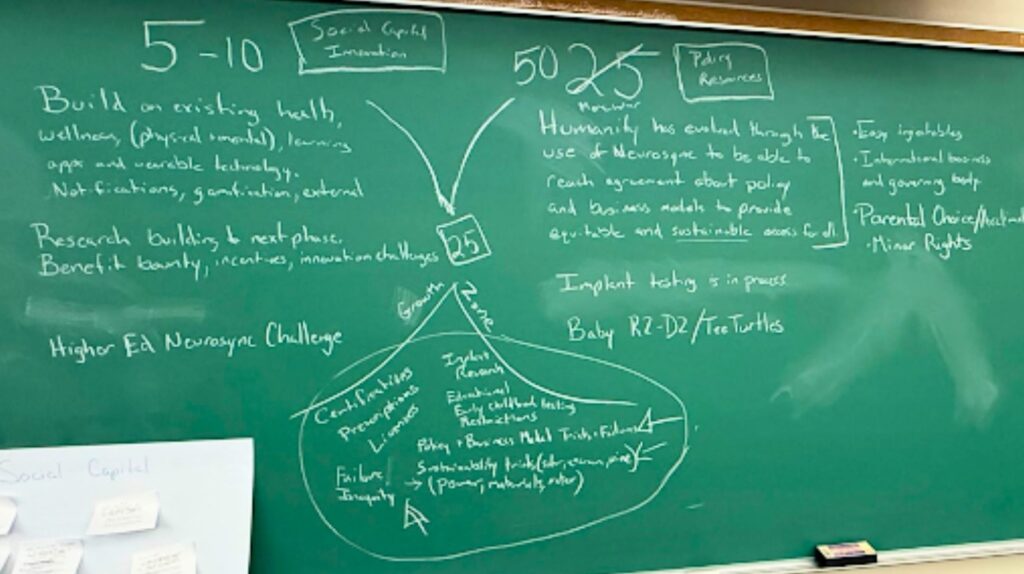
Here’s how you can begin to apply this work in practice:
- Use the 10–25–50 structure to reframe your next planning or strategy session. Invite your team to map near-, mid-, and long-term goals, and consider who is centered in each phase.
- Create a future timeline that pairs your organization’s direction with external drivers like technology, climate, policy, and culture.
- Invite diverse stakeholders — students, staff, community partners — to co-design those futures with you.
- Use storytelling as a strategic tool. Write speculative stories about your institution or initiative 50 years from now, then work backward to identify the steps needed to make them real.
- Run a scenario sprint using one of the futures from this guide. Break the work into 10, 25, and 50-year phases and explore how solutions might unfold.
- Turn the Common Threads into design principles. Use them to evaluate existing work, surface tensions, or guide a new initiative.
- Pilot one of the proposed solutions. Whether you’re testing curiosity-centered assessments, emotional wellbeing infrastructure, or modular credentials, prototype it, document the process, and share what you learn.
- Reconnect to your values. Ask: Are we designing systems that reflect care, trust, learner agency, and long-term stewardship?
The next 50 years aren’t just something we inherit. They are something we write together, with imagination and intention.
Sponsors
Thank you to our sponsors, who made this event and work possible.
Lead partners


Gigabyte sponsor
Megabyte sponsor
Byte sponsors


Interested in sponsoring the 100 Year EdTech Project? Contact samantha@sabconsulting.org
Acknowledgements
It has taken a collective effort from individuals across the country to bring this publication into existence. We are grateful for the creativity and ideas of every individual who personally contributed to the 100 Year EdTech Project. Our authors, participants, sponsors, facilitators and panelists are listed below.
2076 Guide Authors:
Melissa Vito, The University of Texas at San Antonio
Samantha Becker, SAB Creative & Consulting
Jennifer Martin, SAB Creative & Consulting
Angela Gunder, Opened Culture
Lev Gonick, Arizona State University
Jake Erney, The University of Texas at San Antonio
Stephanie King, SAB Creative & Consulting
Amy Buechler-Steubing, The University of Texas at San Antonio
Jenay Robert, EDUCAUSE
Kathe Pelletier, EDUCAUSE
Ruben Puentedura, Hippasus
Mike Yates, Teach for American Reinvention Lab
Joe Lambert, StoryCenter
Brian Arnold
Steven Johnson, Drew University
John Janezic, Arizona State University
Georgia Davis, University of Arizona
Isabella Johnston, Employers 4 Change
Rob Gibson, WSU Tech
Melissa Mahan, The University of Texas at San Antonio
Rachel Arnold, Revo Academy
Claudia Arcolin, The University of Texas at San Antonio
Sean Leahy, Arizona State University
Josh Herron, University of Arizona
Wendy Howard, University of Central Florida
Adam Davi, University of Arizona
Melody Buckner, University of Arizona
2026 Summit Participants
Jeremy Shorr
Beatrice Canales
Annie Davis
Melissa Pasquinelli
Paul Massy
Isabella Bartolomeo
Kaila Gottschalk
Silvina Padilla
Carrie O’Donnell
Josh Herron
Anupom Sen
Noah Schwencke
Nathan Miller
Danette Martinez
Fabian Janysek
Charles Klasson Jr
Robert Freidhoff
Briana Miller
Mackenzie Bishop
Kathe Pelletier
Will Ballard
Brendan Baruth
Nori Barajas-Murphy
Jenay Robert
Sebastian Jimenez
Emma Zone
Monica Wilson
Angela Gunder
Tom Haymes
Crista Copp
Kyle Bowen
Lev Gonick
Zeb Chadwick
Guy Stieglitz
Khanje Johnson
Misty Daiberl
Cesar Rivera
Isabella Johnston
Adam Davi
Sharif Abrar Labib
Laura Everett
Michael Brown
Lindsey Beagley
Kate Krieg
Haley Craig
Monica Tobares
Sarah Montalvo
Marsha Jaramillo
Andy Wisner
Aidan Schatzki
Shelley Howell
Ruben Puentedura
Maia Bland
Sean Leahy
Enrique Carbonell Enriquez
Rob Gibson
Rocio Chavez
Alexia Pollock
Eric Silva
Renee Canete
Jessica Reid
Jasmin Gomez
Mayra Collins
Melody Buckner
Stephanie King
Anita Gabbard
Wendy Howard
Stuart Rice
Erika Bsumek
John Janezic
Elisha Allen
Nancy Luke
Jeremiah-Anthony Righteous-Rogers
Tammy Wyatt
Solomon Gbara
Paul Gonzalez
AnaPaula Ledezma
Joe Tobares
Anita Garza
Başak Büyükçelen
Kael Kanczuzewski
Steven Varela
Claudia Arcolin
Randolph Quinn
Lori Driskill
Melissa Vito
Tina Rettler-Pagel
Melissa Mahan
Shannon Dowling
Marcela Ramirez
Chad Fulton
Robert Duvall
Jess Zeitler
Mark Luetzelschwab
Rick Burnette
Don Orth
Rupal Shah
Rachel Arnold
Steven Johnson
Samantha Becker
Shelly Tornquist
Vivek Vyas
Luciano Oviedo
Michael Stewart
Beth Brunk
Veda Womack
Karen Meadows
John McKenzie
Robert Haight
Cynthia Carroll
Daniel Burgard
Amber Smallwood
Javier No Sanchez
Margaret Young
Paul Marty
Keith Young
Gisele Larose
Rebecca Karoff
Mike Yates
Amy Buechler-Steubing
Alfredo Ortiz Aragon
Sunay Palsole
Errin Heyman
Georgia Davis
Jocelyn Widmer
Jake Erney
Brian Arnold
Amin Q
Meacie Fairfax
The 100 Year EdTech Project 2075 Guide is published under a Creative Commons Attribution-Noncommerical 4.0 license to encourage free and open use, adaptation, and remixing.
Official citation for attribution:
The 100 Year EdTech Project 2076 Guide: Adams Becker, S.; Gunder, A.; Puentedura, R.; Martin, J =. CC BY-NC 4.0
“We look forward to the futures you will design — futures built through collaboration, grounded in purpose, and sustained by communities who dare to create together.”
— Samantha Becker &
Angela Gunder
100yearedtechproject.org